
Case Study: Portal.io Salesforce Integration for High-End AV Installation Operations
Introduction
A high-end audio-visual installation company integrated Portal.io with Salesforce Sales Cloud and Salesforce Field Service to eliminate manual double entry and improve inventory visibility. Prior to integration, accepted proposals in Portal.io had to be manually recreated in Salesforce, and inventory tracking lacked real-time visibility across warehouse and field teams.
Rithom designed and implemented a custom Portal.io Salesforce integration that automatically generated Opportunities and Work Orders, retrieved detailed line-item data, and supported job-specific inventory staging and mobile barcode scanning.
The result was a connected proposal-to-installation workflow with real-time inventory tracking and reduced administrative burden.
This engagement demonstrates how strategic system architecture turns proposal data into operational execution at scale.
Looking for the Strategic Overview?
This case study highlights the implementation. For a broader perspective on how Portal.io and Salesforce integrations reduce operational friction across field service and inventory-driven organizations, read our full article:
→ Portal.io Integration with Salesforce for Field Service and Inventory Visibility
The Challenge
The organization faced three critical operational gaps:
Manual Double Entry
Accepted proposals required manual re-entry into Salesforce, increasing administrative burden and risk of error.
Inventory Blindness
Although inventory existed within Salesforce, there was no clear visibility into product location across the warehouse, staging bins, technician vans, and customer sites.
Lack of Granular Execution Data
Portal.io’s default notifications provided high-level summaries rather than detailed line items. Operations teams need specific products and quantities to execute installations accurately.
Without system alignment, growth would continue to increase operational friction.
The Solution
Rithom implemented a two-step integration and intelligent inventory architecture to create a connected “golden thread” between sales and operations.
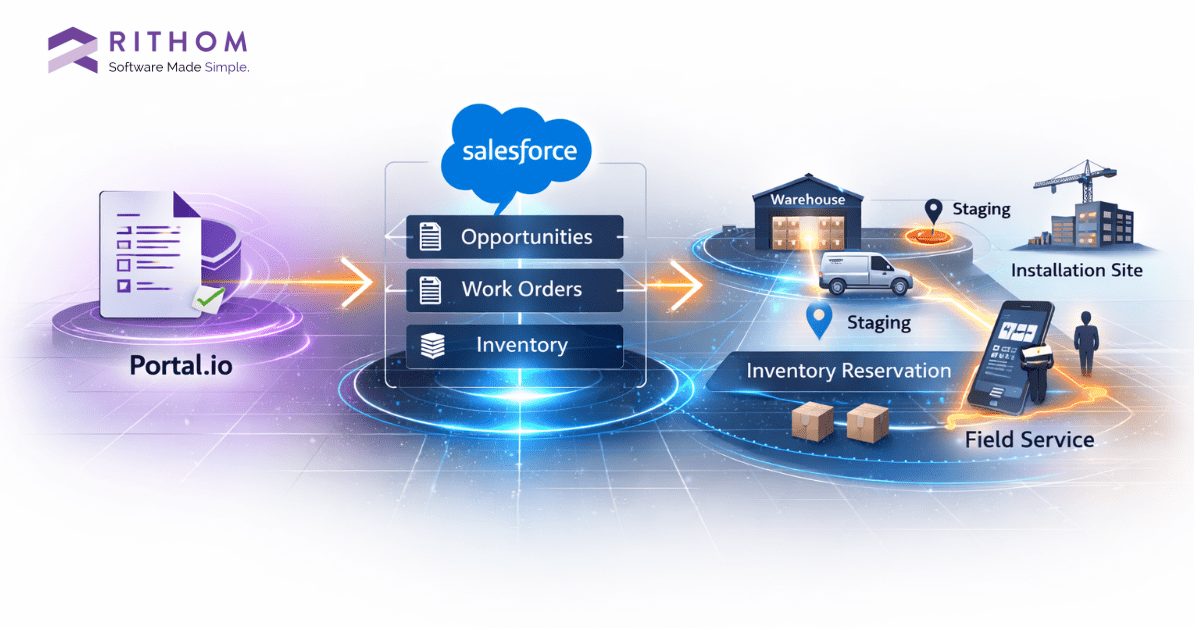
Example architecture connecting Portal.io proposals to Salesforce work orders, inventory staging, and field service execution.
Two-Step Portal.io Integration
When a proposal is signed in Portal.io:
- An Opportunity and Work Order are automatically generated in Salesforce
- A custom integration retrieves detailed line-item data
- Products are mapped into Salesforce for operational execution
This eliminated manual recreation of work orders and ensured data consistency between systems.
Work-Order-Specific Virtual Staging
To mirror the client’s physical warehouse process, Rithom built a virtual staging model inside Salesforce:
- Each work order generates a dedicated staging “bin”
- Inventory is reserved and allocated to that bin
- Technicians retrieve parts specifically staged for their assigned job
This prevents parts from being used on the wrong project and creates clear operational accountability.
Field Service Mobile + Barcode Scanning
Using the Salesforce Field Service mobile app, technicians can:
- Scan products when transferring inventory
- Move items from warehouse to van
- Mark products as consumed on-site
Each scan updates Salesforce in real time, creating a digital chain of custody:
Vendor → Warehouse → Staging Bin → Technician Van → Customer Site → Consumed
This provided accurate, real-time inventory visibility across the organization.
The Results
The integration delivered significant operational improvements:
- Eliminated manual recreation of proposals between Portal.io and Salesforce
- Real-time inventory tracking and chain of custody
- Reduced technician error through barcode scanning
- Improved alignment between sales, operations, and accounting
- A scalable system that no longer depends on tribal knowledge
Salesforce evolved from a partially utilized operational tool into a connected execution platform capable of supporting growth without operational friction.
Key Takeaway
When sales and operations platforms operate in isolation, growth amplifies inefficiency. By integrating Portal.io with Salesforce and architecting intelligent inventory workflows, Rithom transformed a manual process into a scalable, system-driven operation.
Portal.io Salesforce Integration
Connected Proposal to Operational Execution
Portal.io
Salesforce Sales Cloud
Salesforce Field Service
Talk to Our Team
Speak with one of our experts today!
Frequently Asked Questions
A Portal.io Salesforce integration connects proposal data created in Portal.io to Salesforce Sales Cloud and Salesforce Field Service, eliminating manual data entry and improving operational visibility.
Without integration, teams often recreate proposals manually in Salesforce, increasing administrative burden and risk of error. Integration connects sales and operations, improving visibility and workflow efficiency.
Yes. In this engagement, when a proposal was signed in Portal.io, the integration automatically generated the corresponding Opportunity and Work Order in Salesforce.
Yes. The solution supported Salesforce Field Service by enabling inventory staging, mobile barcode scanning, and real-time tracking of product movement from warehouse to installation.
Get Started Today!
Have questions or want to explore how Rithom can help you achieve similar results?
Contact us today — we’re here to help.

About Rithom
Established in 2013, Rithom is dedicated to creating, educating, and optimizing IT and marketing solutions to help businesses reach their full potential. We provide value through affordable growth strategies and are committed to sustaining the highest quality standards in technology implementations. Whether serving as an extension of your team or handling all your IT and marketing needs, Rithom is here to support your business's success.